How a Minor Paperwork Error Disqualified a Measure to Protect Kidney Dialysis Patients
In 2018, a group of Ohioans proposed a state constitutional amendment to strengthen protections for kidney dialysis patients, including annual state inspections of dialysis clinics, new hygiene and infection-control standards, and a cap on what clinics could charge for patient care. The campaign submitted more than enough signatures to qualify for the November 2018 ballot. Despite that, the Ohio Supreme Court disqualified the measure due to a minor paperwork error.
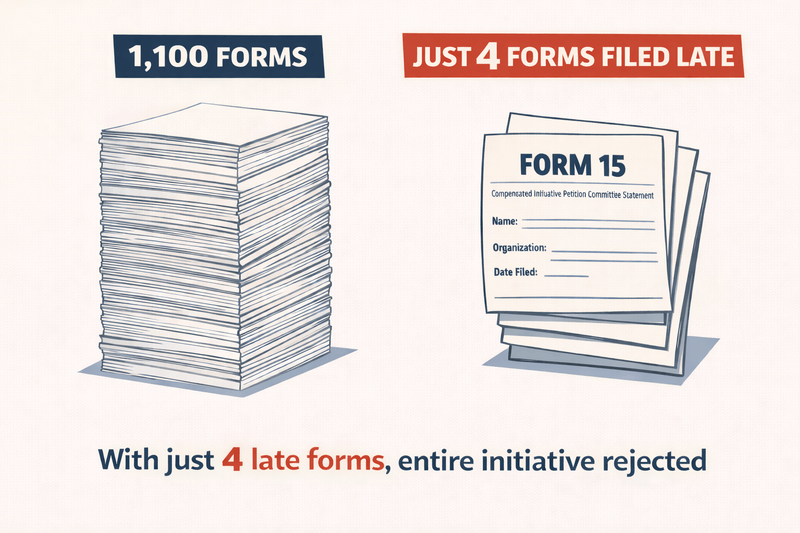
Specifically, the measure’s opponents identified that four of the more than 1,100 people involved in gathering signatures were late in filing a disclosure form indicating that they’d be paid for their work. A 2013 state law mandated this form and imposed a harsh penalty for late filings: the entire petition would be invalidated, no matter how many valid signatures it contained. The court disagreed that this was an unfair—or unconstitutional—penalty and threw out the entire measure. As a result, Ohioans never had the chance to vote on the measure.
Proponents:
Opposed by:
Service Employees International Union District (SEIU-UHW West), a labor organization
The Ohio Renal Association (representing dialysis clinics)
vs.
Proponents brought forward an amendment to:
Mandate annual state inspections of dialysis clinics.
Require new standards for hygiene, sanitation and infection control.
Limit the amount clinics can charge to 115 percent of what they spend on patient care, to be determined by the state Health Department. Overcharges would be refunded to the insurer.
Link: OHIO-Fact-Sheet.pdf
Opponents argued:
Clinics are already regulated under Medicare and state law.
State health officials regularly inspect clinics.
The proposed cap on charges doesn't take into account personnel and other services for operating the business.
The dialysis companies may lose money on patients covered by government programs and make up for it with higher charges to private insurance.
Link: Ohioans could see costly campaign fight over dialysis issue in November - cleveland.com
vs.
Signature gathering completed Aug. 1:
296,080 valid signatures gathered by July 4, 2018.
At least 305,591 signatures were required to get it on the ballot, however.
By Ohio Constitution, proponents were given 10 additional days to gather additional signatures to meet the shortfall.
Additional signatures to more than compensate for the shortfall were submitted Aug. 1.
Lawsuit filed on Aug 2:
Plaintiff argued signatures were invalid because documentation required for paid signature gathering efforts was not filed prior to circulation.
The Ohio Supreme Court ruled in favor of the plaintiffs.
LINK: Ohio Renal Assn. v. Kidney Dialysis Patient Protection Amendment Commt.
vs.
Result:
Because just 4 of more than 1,100 individuals paid to help with the petition were late in filing the form disclosing they would be paid, the entire petition effort was disqualified.
Result:
The Supreme Court decision became the real election.
Once the petition was disqualified:
No vote
No campaign
No public decision
No accountability for opponents’ claims
vs.
Timeline of the initiative:
What happened
Date(s)
Step
Initiative petition filed with Attorney General Mike DeWine
Link: Summary Petition: "Kidney Dialysis Patient Protection Amendment"
January 30, 2018
Proposal filed
Letter from the Ohio Ballot Board (Secretary of State Jon Husted as chair) to AG DeWine certifies the proposal contains a single constitutional amendment
February 20, 2018
Ballot board certified petition
Statewide signature drive after Board approval
February to June 2018
Signatures gathered
After county boards of elections verified signatures, Secretary of State Jon Husted reported that only 296,080 signatures were valid—9,511 short of the required 305,591 initiative signatures.
Link: Ohio Limits on Dialysis Clinics' Revenue and Required Refunds Initiative (2018) - Ballotpedia
July 2018
Petitions filed and signatures reviewed
10-day cure period provided to gather and submit more signatures An additional 41,000 unverified signatures submitted to erase the 9,511-signature deficit
Link: Ohio Limits on Dialysis Clinics' Revenue and Required Refunds Initiative (2018) - Ballotpedia
July 23-August 2, 2018
Unique supplemental petition
August 2, 2028
Lawsuit filed by opposition
Decision meant the amendment could not be put on the ballot
August 13, 2018
Ohio Supreme Court ruled
November 6, 2018
Election day